Service
Dry ice blasting
CO₂-pellet cleaning — non-abrasive, no secondary waste — for plants, commercial equipment, and restoration.
Overview
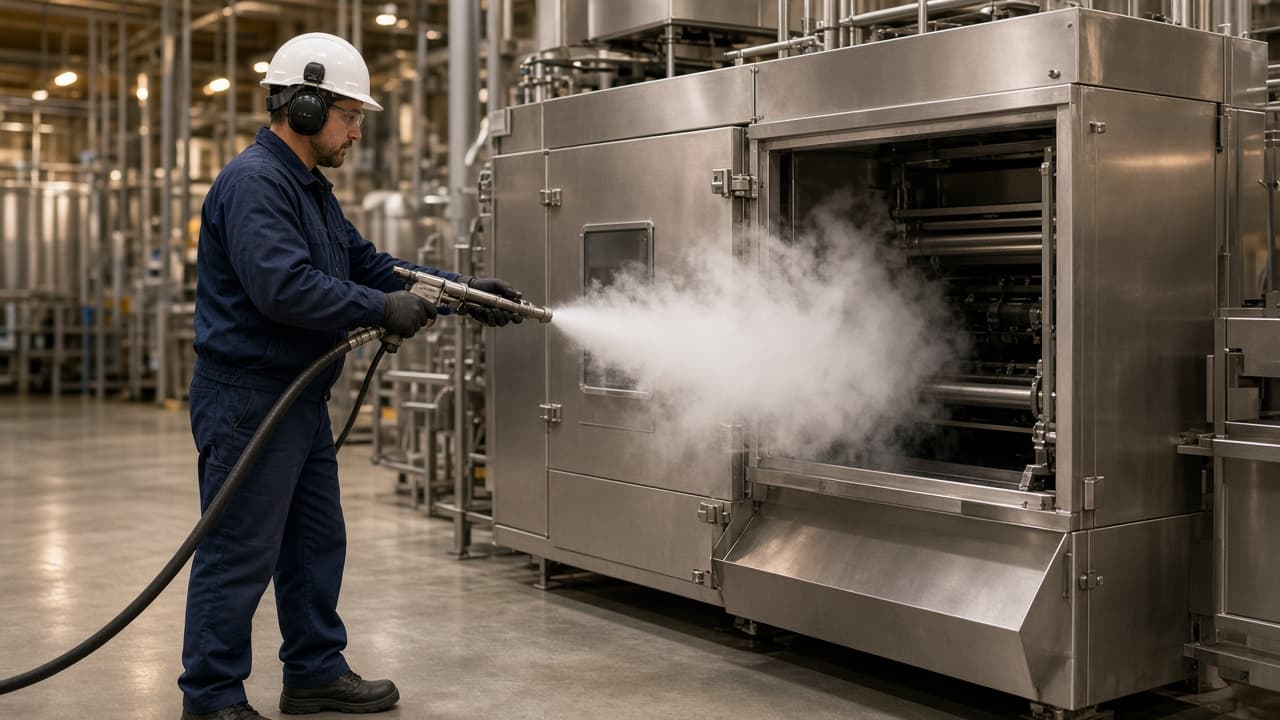
Dry ice blasting hits a surface with solid carbon-dioxide pellets. The pellets sublime — they turn back to gas — so there is no grit pile and no wash-water to haul. The clean is mechanical and thermal, not a sandblast with a different name. MTCPros uses it on plant equipment that cannot come apart for a weekend, on commercial kitchens and print rooms, and on fire or soot work where water would make the damage worse. Arthur’s shop has been sending this trade out from Thamesford because downtime is the real cost, not the pellets.
Who it is for
Plant managers who need equipment cleaned without chemicals or a tear-down. Commercial operators with presses, robots, or kitchens that have to run on Monday. Restoration clients and adjusters after smoke or fire. Building owners with mould, mildew, or odor in wood, brick, or concrete.
How it works
A hopper feeds dry-ice pellets into a stream of compressed air. On impact the pellets fracture the film or residue and then vanish as CO₂ gas. There is no sand, soda, or water left on the floor. Adjacent equipment still needs protection from the blast and the noise; the difference is you are not shovelling spent media into bags at the end of the shift.
- Solid CO₂ pellets — non-conductive, food-adjacent when the plant spec allows
- Non-abrasive on most metals, tooling, and finished surfaces when pressure is set correctly
- No secondary waste: residue is what came off the part, not a pile of grit
Industrial applications
The list is long because the method is mobile and the waste story is short. Typical plant work from this office:
- Food processing — ovens, conveyors, and rooms that cannot take grit or pooled water
- Electrical rooms and cabinets — when the shutdown and lockout allow a dry method
- Printing presses and ink trains
- Robots, fixtures, and weld slag on cells that have to go back online
- Fire and soot after an incident — structure and equipment
- Mould and organic film on wood, masonry, and plant walls
- Preventive maintenance on lines you would rather not pull apart
Commercial vs industrial
Commercial work is often a kitchen, a print shop, or a restoration inside an occupied building — smaller footprints, more protection, tighter hours. Industrial work is a cell, a line, or a room in a plant: access, lockout, and the production calendar decide the day. The method is the same; the logistics are not. We will say which conversation you are in.
Downtime and mobility
The machine comes to the part. That is the point. We set up in a bay, blast in place, and leave the residue that came off the equipment — not a yard of spent abrasive. Shutdown windows are priced as windows, not as a hopeful Saturday. If the job is a house fire or a small commercial room, the same truck still shows up; the crew size changes.
Related
Industrial painting & coatings
Plant steel, equipment rooms, and high-build coatings — surface prep first, product second.
Industrial epoxy & resin floors
Plant and warehouse resin floors — high-build, quartz, and hygienic systems that take traffic, chemicals, and wash-down.
Concrete grinding
Remove failed coatings, thinset, and adhesives — and leave a slab that can take a new floor or stay as a working surface.
Demolition
Interior, exterior, and selective demolition — including the cleanup that lets the next trade start.
Interior painting
Residential interior paint — rooms and whole homes — with the prep that decides whether it lasts.
Talk to the office
519.295.0085
116 Dundas Street West, Thamesford. Primary service area: Southwestern Ontario. We also take projects across Canada and the United States. Call, email, or WhatsApp — or send the estimate form and we will reply from info@mtcpros.ca.